Use custom apps
Prior reading: Cloud apps overview
Purpose: This document explains how to create custom apps in Workbench using dev containers.
Introduction
Verily Workbench users can create custom cloud apps that can be shared with other users in the same workspace. These apps can be run on GCE instances for GCP-based Workbench workspaces. Workbench uses development containers to support app configuration and management. The Development Container Specification for examples in Workbench can be found in the workbench-app-devcontainers repository.
Dev containers
Dev containers stands for "development containers." Workbench runs
your apps in an isolated container in a
VM. To define an app with a dev container,
you must create a .devcontainer.json file.
Containerized apps
.devcontainer.json supports Docker images,
Dockerfiles, and Docker Compose. To customize your container
with Dockerfile or Docker Compose, see
Using Images, Dockerfiles, and Docker Compose.
Dev Container Features
Besides Docker, Dev Container Features is a powerful dev container tool for adding tools and libraries into your containers. Here is a list of available features.
You can clone over the R Analysis Environment app example definition from
workbench-app-devcontainers
and then add your custom features. For example, if you want to add RShiny packages into R Analysis
Environment, you can install the R packages through devcontainer-features/r-packages feature.
"features": {
        "ghcr.io/rocker-org/devcontainer-features/r-packages:1": {
            "packages": "shiny,shinydashboard",
            "installSystemRequirements": true
        }
    }
Create your own app with dev containers
If you want to create your own custom applications, the simplest way is to modify the Workbench template. Alternatively, see devcontainers/templates for more dev container templates. If you choose to use these templates, there are some Workbench specific requirements that you must satisfy in a separate docker-compose.yaml file that lives in the same directory as the dev container template:
- The app must be running on
app-network. - The app port is exposed on
localhost. - If you want to sync the workspace bucket files
to your working directory, set
--cap-add SYS_ADMIN --device /dev/fuse --security-opt apparmor:unconfinedto the Docker container.
Publish your custom app to Git
You can publish your custom app dev container to a public or private Git repository for Workbench to reference it. For examples of a custom app dev container, see Devcontainer for R Analysis.
Create and launch a custom app in Workbench
To launch the app from the Workbench web UI, follow the steps below.
Note
If you're using adevcontainer.json definition in a
private Git repository, you must first link your GitHub account to your Workbench profile and
give permissions. See Link your GitHub
account for instructions.
-
First, select Custom, then choose Next.
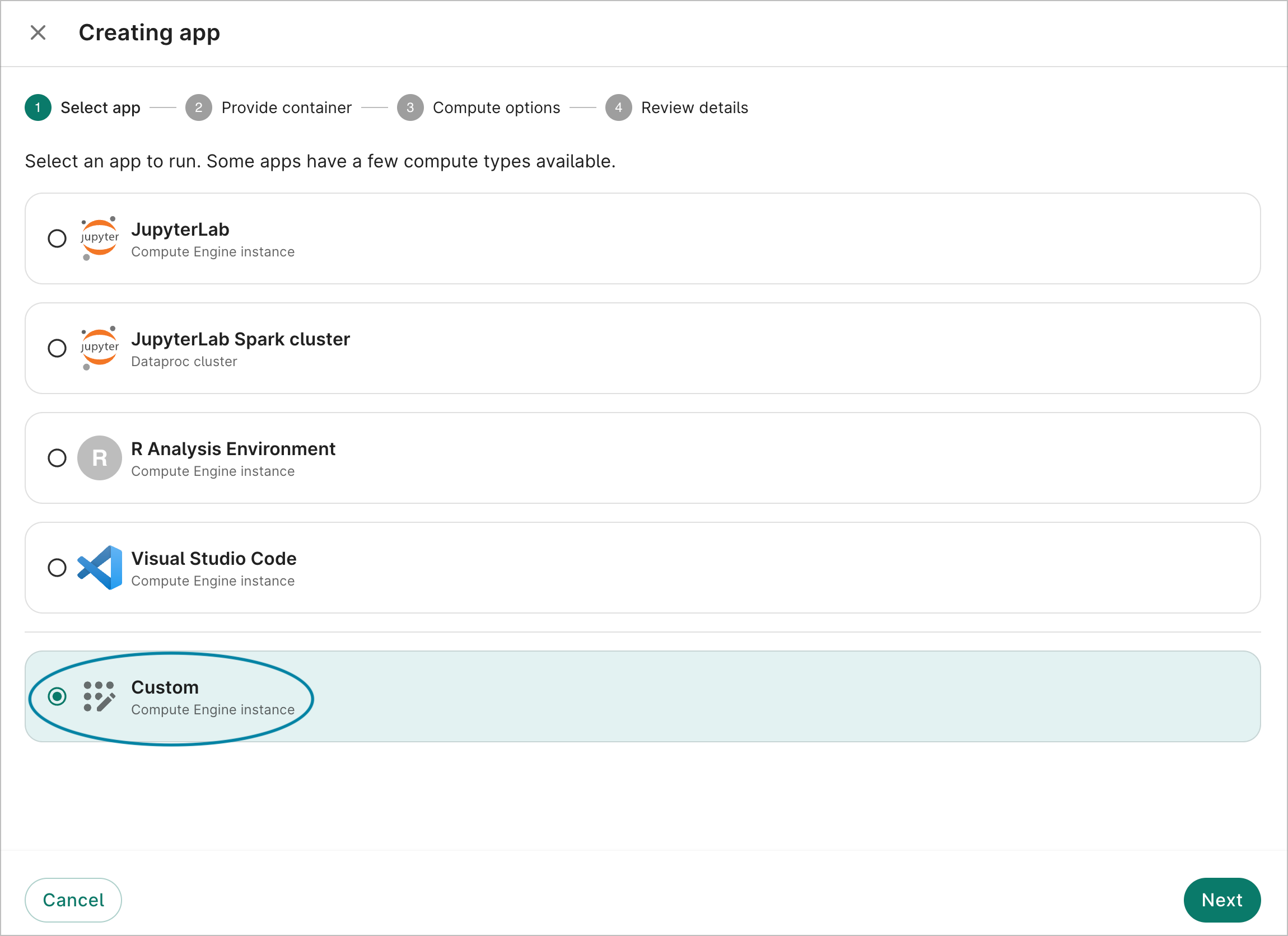
Create a custom app. -
Provide your Git repository URL and the folder to your
devcontainer.jsondefinition if it's not in the root folder. It should look like this: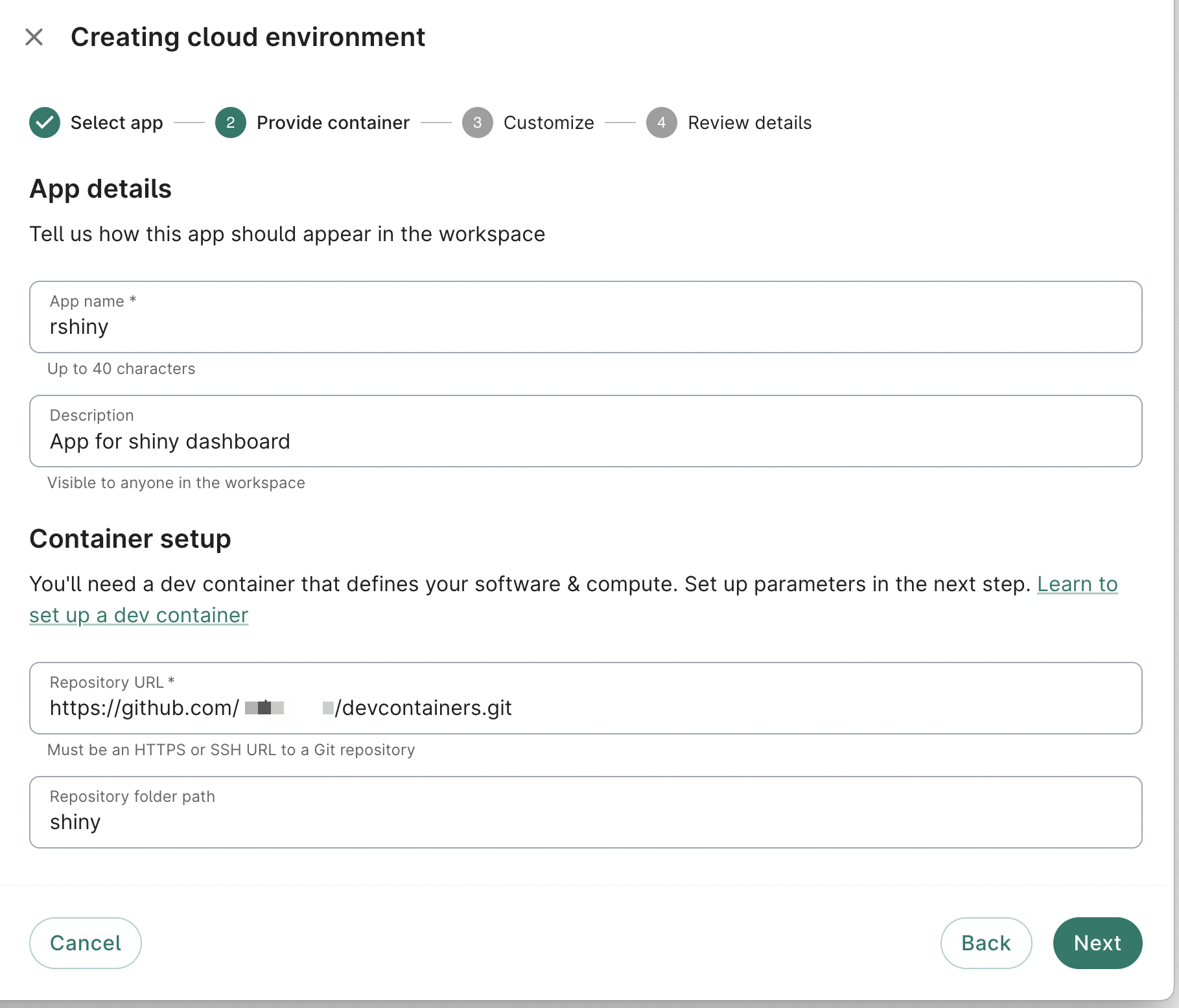
Provide custom app definition. -
Continue creating your app by configuring CPUs, GPUs, and the autostop idle time. Once the app is created, its definition will be available for everyone in the workspace and will appear in the Select app list the next time you create a new app.
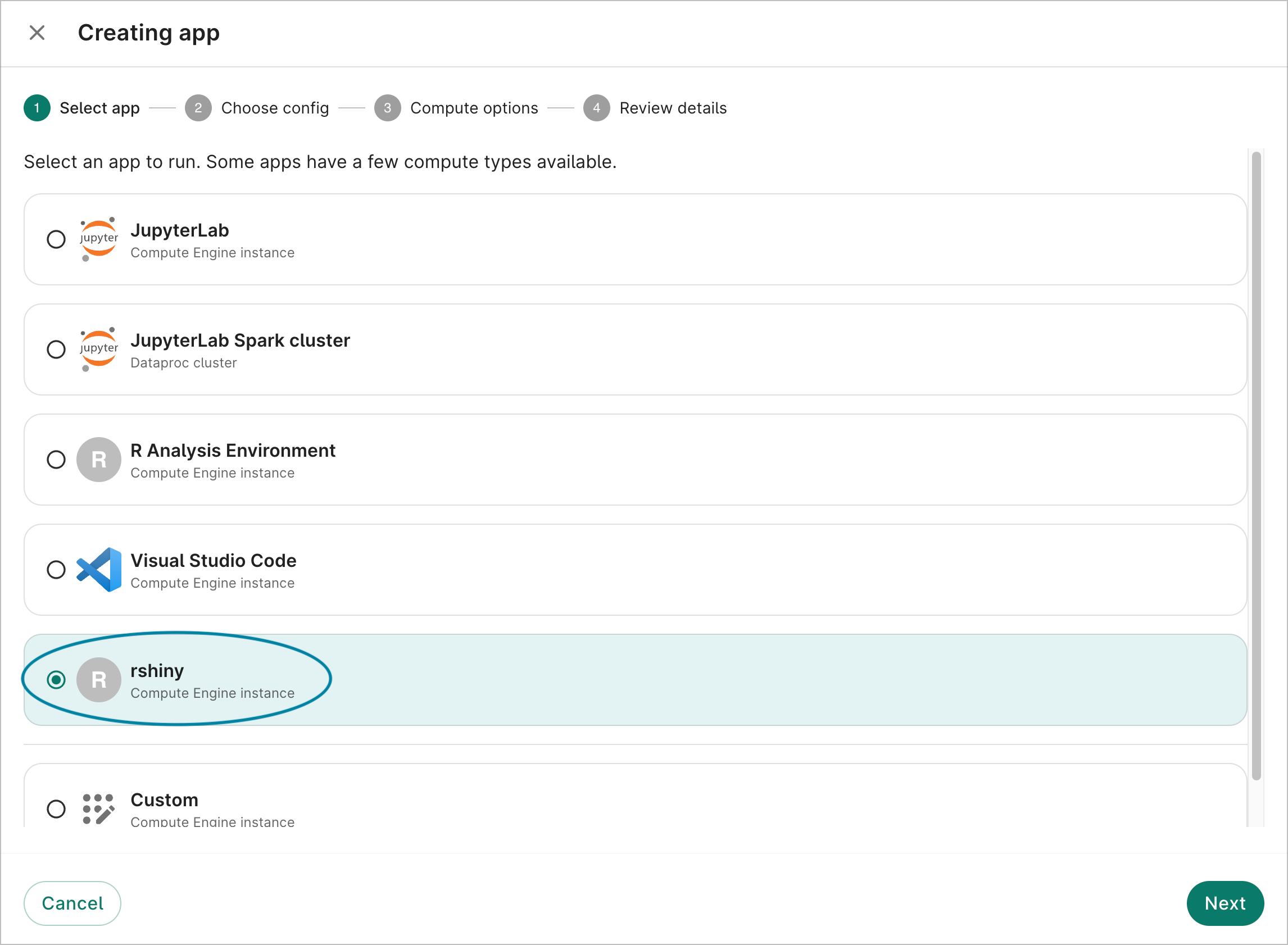
The custom app can be selected when creating a new app. Note
If you don't have access to the GitHub repository where the defined
devcontainer.jsonfile lives, you'll see an error when trying to create the app.
An error message is shown when the devcontainer's GitHub repository can't be accessed.
Last Modified: 11 November 2025